The dispersed nature of today’s workplace requires employees to put forth more effort to stay connected, well-informed, and productive. Employees are consuming large amounts of data and information in the process of interacting with their teams and clients. With this mountain of data growing by 35-50% annually in most organizations (MIT Sloan Management Review), it’s just a matter of time before the deluge of information becomes too much to take in. As workplaces become more and more competitive, employees demand their tools have smoother capabilities so that they can work faster and better. Simple and seamless collaboration comes into play here: tools live AV integrations allow users to collaborate with anyone, from anywhere, and at any time, knocking down all possible barriers to communication.
Effective Collaboration offers major payoffs in the form of faster results, educated decisions, and boosted productivity. But, for collaboration to be effective in the new workplace, it needs to address the challenges of remote communication while producing the results that conventional, face-to-face communication brings. Adopting a strategy that incorporates voice and video with easy-to-use tools will win the day.
Across the organisation, remote teams are required to interact on an ongoing, uninterrupted basis. Our goal is to allow them to collaborate in the same way that they would if they were in the same room. In a way, it should be as easy as walking to the next cubicle, even if the person is actually quite a few time-zones away. Moreover, the high engagement of collaboration solutions will keep remote employees motivated and foster team building.
Collaboration tools that enable seamless collaboration without the use of complex technology will meet the organization’s goals while giving employees an incentive to embrace such tools – a simple and no-frills solution that gets their job done.
Studies have found that companies that have effective and secure collaboration systems in place can bring innovative products to market quickly, improve operating efficiency, increase customer loyalty, and drive more revenue in sales. However, many organizations struggle to build effective collaboration environments that help them achieve their business goals. According to estimations, nearly 80% of enterprise collaboration initiatives fail for several reasons. What makes it hard for companies to create environments conducive to more effective, seamless, and simpler collaboration? Here are some of the biggest roadblocks in deployment of effective collaboration solutions within an organization:
Not having a proper strategy for collaboration
Most organizations often introduce collaboration solutions without a proper strategy. This face-it-as-it-comes attitude doesn’t work in the long run, especially today when technology is changing faster than ever, and requirements are likely to scale up or down at random speed. Without a plan, organizations are frequently left grappling with whatever solution they must meet a particular need. And often, the solution isn’t the best one. Not only that, businesses that don’t have a proper plan for deploying collaboration solutions are more likely to make useless investments on tools and solutions they don’t need. Our seasoned Digital Strategists will clearly articulate our client’s digital aspiration and intent, designing an achievable digital strategy. We adopt a holistic approach with the understanding that achieving a digital aspiration does not rely only on technology and we ensure that all critical dimensions are addressed in the strategy.
Focusing on technology, rather than on people and process.
Most organizations make the common mistake of giving almost 80% of their attention to technology, and only 20% of their attention to the people who use it and what they use it for, accounting for some of the major problems in collaboration tech adoption. Adoption lags if it fails to deliver according to the users’ expectations. Therefore, rather than looking for a silver bullet in the technology, organizations should focus on the specific problems for employees and how technology can provide the solution. We bridge the gap between concept and execution and specialise in translating a strategy into a realistic, practical execution plan, highlighting all aspects to be considered in a holistic approach to building digital solutions. Our plans ensure execution success through the selection of the most appropriate execution methodology, prioritising initiatives and managing interdependencies.
Addressing the need for ad-hoc collaboration
It’s important for a collaboration solution to meet the requirements of ad-hoc communication as part of everyday productivity for dispersed teams. When collaboration becomes as easy as making a phone call, it results in significantly better outcomes. Improved productivity, better resolutions of problems, quicker decision-making, and more quality engagement between teams, client, and consultants.
Finding simple-to-use enterprise-grade collaboration solution
With trends like BYOD witnessing widespread adoption, employees are not only using their personal devices to do their office work, but they are also using many free and easy-to-use applications to collaborate internally as well as externally. While applications like Hightail, Send Space, or DropBox offer simpler and faster sharing of files and documents, they do carry high security risks since there is virtually no control over what goes out of the organization and where it goes. For example, Dropbox support documentation says: “other users can’t see your files in DropBox unless you deliberately share links to files or share folders.” However, accidental sharing could lead to leakage and breaches of security.
Organizations need to offer their employees business-grade collaboration solutions that are safe and simple-to-use, to discourage them from using less-secure means, thus jeopardizing the privacy and security of their organization. So, while collaboration needs to be as easy as a phone call, also it needs to have multi-layered security to prevent the risks of data leaks that can cost an organization in terms of revenue, value, and reputation.
We fulfil the role of a partner, advising our clients on the most appropriate and most contextually relevant journey to adopt for them to achieve their digital aspirations. We start by working with the client to establish their current digital maturity and capabilities, relative to the evolving business landscape, latest digital trends, and best practices.
One of the main reasons of the success of our organisation is the company wide ingrained importance attached to an attitude of constantly discovering, challenging, and improving on the solutions that we deliver to our customers, we embrace disruption, and our people remain curious and focused on exploring new trends and opportunities to ensure that we grow with our customers. Everything we do is cantered around delivering an unbelievable experience for our customers and as such we have developed the Innovation and Constant Improvement Programme that enables us to meet our main purpose in our organisation which is to ensure that we provide our customers with the best possible experience and value for money.
Service Improvement
DumaTera is constantly looking at how can do things better, quicker, in a simplified and more cost effective way for our customers. We have internal programmes that we run and various processes that we follow to drive these initiatives further and faster.
- Analysis of al Projects with our Customers, any actions are then allocated to the relevant department to investigate and if required implement the necessary process updates to ensure constant improvement.
- OEM Forums with various OEM where we discuss new trends and tools in terms of service improvement, any actions are then allocated to the relevant department to investigate and if required implement the necessary improvements.
- Customer Forums where customers share experiences and ideas, any actions are then allocated to the relevant department to investigate and if required implement the necessary improvements.
- Detailed Root Cause Analysis of any major outages to ensure that we minimize repeat outages and if required implement pre-emptive actions at all customers.
- Customer Relationship Managers are in constant contact with our customers to independently evaluate where can we do better and are also responsible for ensuring that any finding is followed up on and feedback provided to the customer.
- Constant Feedback is expected to be provided to our customers by all our people ensuring that our customers are always kept abreast of developments.
- Open Door Policy at Duma Tera we have always had a mentality that we strive to delivery an awesome experience to all our customers and as such we have an ethos within our organization that everyone within the organization (including our CEO and his Leadership Team) is always ready at any time to assist a customer with whatever the query or need they may have.
Innovation
It is no secret: innovation is an important part of remaining ahead. The significant success of an organisation can be better achieved through game-changing creativity and less through optimizing existing businesses. Since innovation is a complex, company-wide endeavour, it requires a set of crosscutting practices and processes to structure, organize, and encourage it, therefore we have developed a programme to deliver and organize for innovation repeatedly over time and with enough value to contribute meaningfully to overall performance.
- Constant Education and Learning all our client facing resources have personalised training schedules allocated that need to be completed on an annual basis, the subject matter that they are trained on is evaluated by our Product Management department that keeps abreast of all major relevant trends in the market pace to ensure that they are able to inform our customers of any major new developments and ensure that our designs are always forward looking and in line with our customer strategies.
- Analysis of Relevant Market Trends we constantly keep abreast of relevant new trends that are emerging and ensure that these are incorporated into our strategies and discussions with our customers ensuring that they are early adopters new mainstay trends and strategies where appropriate.
- Technology Update Forums we regularly arrange technology update forums with our customers either on an individual basis or in the form of conferences or workshops, to ensure that clients are abreast of technology developments.
- Interactions with OEM’s and Conferences and Expo’s on an annual basis together with our OEM partners we host customer delegations to relevant leading conferences, with the aim of together with our key strategic customers evaluating new products and trends, these sessions are always followed up by several intensives workshops where we jointly decide on any short-medium-long-term strategy changes or adoptions.
What is unified communications?
Unified communications (UC) is an umbrella term for the integration of multiple enterprise communication tools — such as voice calling, video conferencing, instant messaging (IM), presence, content sharing, etc. — into a single, streamlined interface, with the goal of improving user experience (UX) and productivity. Unified communications technology supports a user’s ability to switch seamlessly from one mode of communication to another within a single session, whether on a desktop computer, laptop, tablet or smartphone. For example, someone might initiate a conversation via chat before escalating the interaction to a video conference with a single click, without having to open a separate, video-only application. Many UC systems also integrate with third-party business applications, such as project management software, to enable the centralization of information and resources, as well as more efficient workflows.
UC technology facilitates the integration of software that supports both real-time communications (RTC), such as voice over IP (VoIP), and asynchronous communication, such as persistent chat, so the end user has easy, immediate access to all relevant tools in a consistent environment, from any physical location and digital device. Many UC offerings also include — or even hinge on — team collaboration tools, which have messaging-centric workflows and cooperative features such as real-time file sharing and annotating. These next-level UC systems are also referred to as unified communications and collaboration (UCC).
The increasing popularity of unified communications is part of a larger digital transformation and cloud migration under way across today’s enterprises. The COVID-19 pandemic greatly accelerated this shift, with many organizations relying heavily on UCC technologies to enable remote work.
How does unified communications work?
A unified communications environment is typically supported by one or more back-end management systems, sometimes referred to as UC platforms, that facilitate integration among services, as well as the front-end clients that provide access. For example, a web conferencing system would make use of an audio conferencing system — which, in turn, would be built on an underlying Internet Protocol telephony platform — and a Unified messaging client would allow click-to-talk, click-to-chat or click-to-video functionality.
and their components can be deployed on premises, in a public or private cloud, or as a combination of all three. Cloud-based UC services, also called UC as a service (UCaaS), are gaining traction. An open source project called WebRTC enables RTC to be embedded into web browsers. This provides users the option of accessing services via Google Chrome, for example, rather than a downloadable, standalone app.
Historically, single-vendor UC environments have demonstrated the tightest integration and compatibility. Interoperability among vendors remains an ongoing challenge in UC, but it has also been mitigated, in part, by partnerships, common protocols and open application programming interfaces (APIs).
What are the benefits of unified communications?
UC is often credited with increasing employee productivity, supporting more communication and collaboration than the legacy phone system.
Additionally, specific technologies, such as video conferencing, are linked to reduced travel costs, greater efficiency, more flexibility and better engagement. With UC technologies, employees can work from the office, their homes or the road using a variety of devices, from desktop and laptop computers to mobile devices.
The benefits of unified communications can also stretch to an organization’s customer base. Organizations that integrate UCaaS solutions with social media, customer-facing apps or call center platforms can directly engage with their customers — or students or patients in the education and healthcare sectors, respectively — providing real-time feedback and improved service to boost customer satisfaction.
What are the components of unified communications?
The suite of tools that a UC platform might offer includes the following:
- email;
- text messaging;
- persistent chat;
- mobility;
- real-time presence;
- telephony (fixed line, mobile and VoIP);
- voicemail;
- screen sharing;
- audio transcription;
- audio conferencing;
- video conferencing, room-based video conferencing and TelePresence;
- web conferencing, virtual meeting spaces and interactive whiteboards;
- calendars, scheduling and other personal assistant functions; and
- enterprise social networking and collaboration platforms.
On the back end, a strong communication system may include the following:
- a single- or multivendor UC platform or server;
- a traditional, IP or cloud-based private branch exchange;
- devices such as phones, headsets, cameras and microphones, which are also user-facing tools;
- business communication gateways, such as session border controllers; and
- a multipoint control unit, or video bridge, for video conferencing with three or more endpoints.
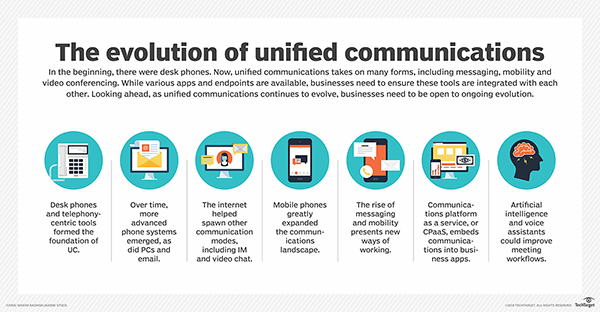
The digital transformation of the enterprise has seen UC evolve far beyond rudimentary telephone systems to include video conferencing, team messaging, virtual collaboration and more.
Differences between communications and collaboration
UC and team collaboration tools overlap significantly, and vendors, IT pros and end users increasingly use the terms interchangeably. Technically, differences between business communications and collaboration exist, however, depending on how workers interact, and for what purpose, while using a given tool or feature. Email, for example, enables communication between two or more parties. And, while those parties might send and receive messages in the spirit of cooperation, their communication isn’t necessarily collaborative.
Collaboration, on the other hand, involves interactively working together toward a concrete shared outcome. Imagine that a group of sales professionals needs to plan a client presentation. If they convene on a video conferencing platform to discuss the upcoming meeting, they are communicating. But, if they also have a single shared document in the cloud — perhaps, a presentation outline, PowerPoint file or virtual whiteboard — where each user can make changes the whole group can see, then they are also collaborating. While communication can exist without collaboration, collaboration is impossible without communication.
Why might the difference between business communications and collaboration matter? Vendors increasingly package an array of connectivity and productivity applications in their UC offerings, sometimes inaccurately describing communication features as collaborative. Customers should understand the difference between communication and collaboration, if only to have confidence they will get the value they need from any given platform or tool.
What are technologies related to UC?
UC overlaps with contact center technologies in the form of automated call distribution, interactive voice response and automated attendant systems, video chat functionality, and messaging capabilities. Integrating internal and external UC capabilities — with in-house and customer-facing communications happening on the same platform and over the same channels — can eliminate departmental silos and improve customer outcomes.
Other types of UC offerings embed enterprise communication tools into business processes. This concept, known as communications-enabled business processes, has evolved into communications platform as a service (CPaaS) and the use of communications APIs. Services such as presence, chat and telephony can be integrated into business applications that span the entire organization. For example, users can launch a voice call directly within a customer relationship management application.
UC risks and security issues
The biggest security challenges a business faces when implementing and maintaining its UC infrastructure are managing users’ identities and access and securing data. UC strategies focus on connecting disparate technologies operating on an array of different networks, so the challenge becomes ensuring each disparate access point is secure, no matter the device or the network on which it is operating.
Additionally, UCaaS and bring your own device (BYOD) environments are becoming increasingly prevalent in enterprises. Both approaches spread out an organization’s data and increase the attack surface. UCaaS also places a portion of the security responsibilities in the hands of a third-party vendor and requires an organization to thoroughly vet the security practices of the service provider.
Another potential UC security vulnerability is the exploitation of open APIs. Traditionally, open communication APIs are used to streamline workflows by enabling an organization to add customizable communication features to existing applications, removing the need for employees to switch between applications for communication. However, the open nature of the API leaves room for access credentials to be stolen. If credentials fall into the wrong hands, potentially sensitive data could be leaked.
Other significant security issues enterprise UC faces as a result of compromised access procedures and poor encryption include the following:
- content theft, in which a malicious actor intercepts enterprise traffic;
- denial-of-service attacks, in which an attacker targets specific IP ports related to UC services and overloads them with traffic to damage service; and
- service hijacking, in which an attacker sells access to a company’s UC applications, such as VoIP, and, consequently, causes UC costs to increase dramatically.
Organizations can take a few steps to ensure they are practicing good access management, including the following:
- Granular access.Define user roles and levels of authorization based on those roles to limit access to sensitive data.
- Audit trail.Keep track of which users are accessing an API and how they are doing it. Doing this will help organizations monitor suspicious activity.
- Organizations using a CPaaS provider should inquire about their service provider’s level of encryption.
- Security awareness.Employees should understand the importance of data security and practice good security habits, such as creating strong passwords and using trusted networks when accessing enterprise UC applications.
Unified communications platforms
When choosing a unified communications platform, an organization should ensure its preferred vendor offers a product that meets the organization’s unique needs and has strong security practices in place. Some popular UC platform vendors are the following:
- 8×8 Inc.offers a contact center integrated with Google Cloud’s Contact Center AI, which adds real-time customer experience analytics and a virtual agent capability that can answer routine customer calls. Virtual agents can improve customer service by reducing call times.
- Avayaoffers the Avaya OneCloud UC platform. Avaya is one of the few UC vendors that still offers adequate on-premises solutions in a field that is moving swiftly to the cloud.
- Ciscohas a variety of UC products and services for on-premises deployment and the cloud, including Webex Calling, Jabber, Unity Connection for voice messaging and Single Number Reach for extensive telephony features.
- CounterPathrecently introduced its new team collaboration platform, Bria Teams. The cloud-based service is best suited to small and midsize businesses. One feature of the platform is a dedicated high-definition virtual meeting room, which eliminates the need for team members to schedule a physical meeting. Bria Teams and Bria Teams Pro also include chatrooms that track conversation history across multiple devices.
- Fuzeoffers voice, video, team chat and collaboration tools as part of its flagship UCaaS platform. Additional UCC features include file-sharing and contact center capabilities. The company guarantees 99.99% uptime.
- Microsoftoffers Microsoft Teams for Microsoft 365, which integrates chats, meetings, calls, files and collaboration tools in one place. Users can customize their Teams platform with add-ins (applications) from either a third party or Microsoft. Users can also build their own application for Teams under the Microsoft 365 Developer Program.
- Miteloffers a range of telephony and UC options, including MiCloud, MiCollab and MiVoice, that cover businesses of all sizes. Mitel is another one of the few vendors still investing in on-premises UC solutions.
- RingCentralwas an early major UCaaS player and, now, has one of the largest subscriber bases in the world, according to analysts. The cloud-based RingCentral Office platform has VoIP, messaging and meeting capabilities and is available in more than 40 countries.
- Unifyprovides VoIP calling, video conferencing, team messaging and file sharing on its Unify Circuit platform.
Criteria an organization should consider during the decision-making process include the following:
- Range of services.We offer different levels of service. From a small range of foundational UC applications, like telephony, IM and basic conferencing, to comprehensive, full-scale services, such as call recording, video, screen sharing and file sharing. DumaTera offers a large range of services that enable customers to start with the basics as needed.
- We specialise in different areas of unified communications, we focus on telephony-based communications, mobility and collaboration.
- Deployment model. Organizations can choose between implementing on-premises UC platforms, cloud-based platforms or a hybrid solution that mixes both models. Organizations with an apt IT department may consider operating on-premises solutions, whereas smaller businesses may opt for a hybrid or hosted option in which aspects of the platform are managed by a third-party provider. Many users are making the transition to cloud-based services.
What is the future of unified communications?
The UC market is going through a period of significant transformation, particularly when it comes to UC’s migration to the cloud and the growing dominance of UCaaS over purely on-premises deployments. The COVID-19 pandemic dramatically hastened this shift by forcing an unprecedented percentage of the workforce to work remotely. According to a Metrigy survey, the percentage of organizations using UCaaS increased by 79% between 2019 and 2020, with more than 60% of organizations speeding up their adoption plans.
Going forward, as employees return to the office, it’s clear they must have the ability to communicate from anywhere on a moment’s notice. Many experts also expect enterprises to permanently embrace a hybrid work model, with a mix of in-office and remote employees. These factors make cloud-based UC technology attractive and, in many cases, necessary.
Before the COVID-19 pandemic hit, vendors were already shifting their focus from on-premises products and support to investment in cloud-based products and will likely continue to do so in the months and years ahead. Organizations that plan to stick to on-premises solutions for the foreseeable future should be aware that only a select few vendors are still making a point of investing in on-premises UC and there may not be adequate support for this type of infrastructure in the near future. On the other hand, some experts argue that escalating cyberattacks on cloud services make a compelling case for on-premises UC systems, which offer organizations greater control over their own security.
In addition to ongoing cloud migration, users can expect vendors to continue to partner up and collaborate in creating stacks of UC tools, which can help companies capitalize on each other’s strengths and improve compatibility between their respective products.
Lastly, emerging technologies, such as artificial intelligence (AI) and machine learning, are anticipated to have an impact on the field — although, its less clear exactly how. In addition, only 5% of companies surveyed by Metrigy used AI in their UC and collaboration experiences; 43% of companies were considering it. Some uses for AI in UC could be to break down language barriers and to improve UX.